Kayunga farmers trained in organic farming
3 min read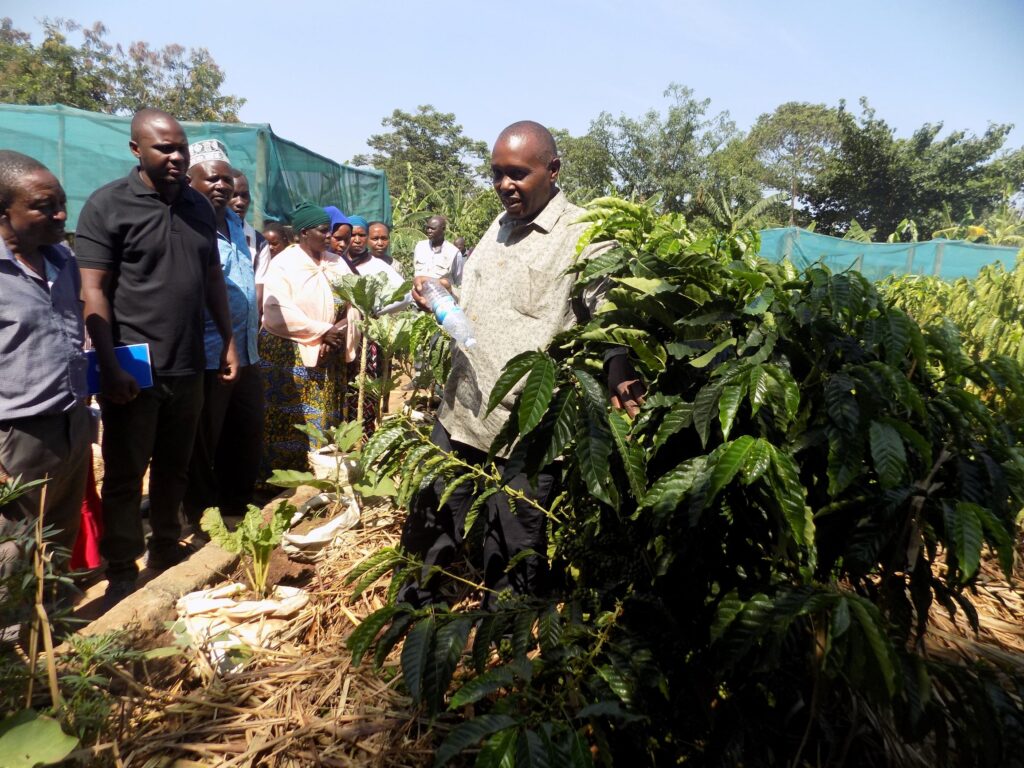
Davson Musasizi explains to farmers how to grow coffee in an organic way at Busoga Farmers Resource Centre. Photo by Christopher Bendana
By Christopher Bendana
Busembatia
Over 30 farmers from Kayunga district are enthusiastic about incorporating organic practices on their farms after attending a one-day organic farming training at Busoga Farmers Resource Centre in Busembatia Town Council on Thursday.
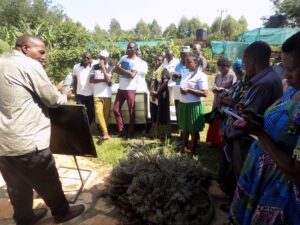
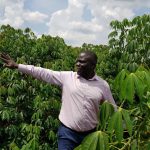
The training began with a field excursion at the Centre, led by its founder and owner, Dawson Musasizi.
The excursion opened with a sermon from the farmer-pastor, who said the key to success was mindset change; the will to learn and re-learn new ideas. The phrase “Mindset Change” is central to his thinking, even appearing on the signpost at the entrance of the facility: Busoga Farmers Resources for Mindset Change.
“Here we use mindset change,” he told the farmers.
He spoke to the farmers about the importance of food in human needs and how God had placed Adam in a garden for a reason. He revealed to the visiting farmers that he does not buy food and that they would have lunch from food sourced at the farm, not from someone else who is mainly interested in money.
“Start with what you eat. It is safe. Or you are buying food from farmers who are just interested in profit,” he argued.
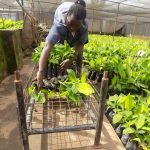
The over one-acre integrated model farm has vegetable sections, a banana plantation, a coffee section, poultry, cows, a fish pond, and a section for animal feed production from insects, including black soldier flies.
He works with resources in the same environment. The cow dung provides electricity to run the kitchen as well as manure for the vegetables. The black soldier flies provide food for the poultry. He makes several juices from the vegetables and fruits, which he sells at the shop on the facility.
“Start small, and work as a family,” he advised the farmers, many of whom were women small-scale farmers.
He taught the farmers how to make animal feed from black soldier flies, how to make compost manure from pineapple waste, how to manage soils, and livestock management.
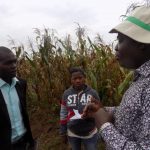
Complementing Musasizi’s lecture, Samuel Nyanzi, board chairman of the National Organic Agricultural Movement of Uganda (NOGAMU), taught the farmers the key principles of organic farming, including crop diversity, the safety of the food produced, care for others — including consumers of your food and workers on the farm — and the environment in general.
He encouraged the farmers to work in larger groups to benefit from economies of scale, but also to comply with organic standards.
Marilyn Kabalere, Head of Advocacy at NOGAMU, encouraged the farmers to adopt the use of energy for value addition and water for irrigation, as at Musasizi’s farm, to increase their productivity.
“We want people to earn money from organic farming,” she said.
She said the Organic Law would protect genuine organic farmers from those claiming to be organic when they are actually not.
Brian Bukulo, a pineapple farmer from Ndeeba in Kayunga district, said the practical experience of learning to make animal feed from black soldier flies was something he would incorporate into his business.
“I had only seen it on TikTok,” he told Sciencenowmag after the training.
Irene Bireyeri, another trainee, said she had appreciated the importance of mulching after seeing Musasizi’s plantation in this dry season, and she was going to incorporate compost making since she already has a cow.
“My cow dung has been going to waste, washed away by storm water. But no more. I am going to use it to make manure,” she told Sciencenowmag.
The organic movement has been gaining traction as health experts and environmentalists warn about food produced through industrial agriculture, where there is heavy use of insecticides and other synthetic farm inputs. They warn of the negative impact on the environment, especially on soils, as well as on the health of the organisms consuming these foods.